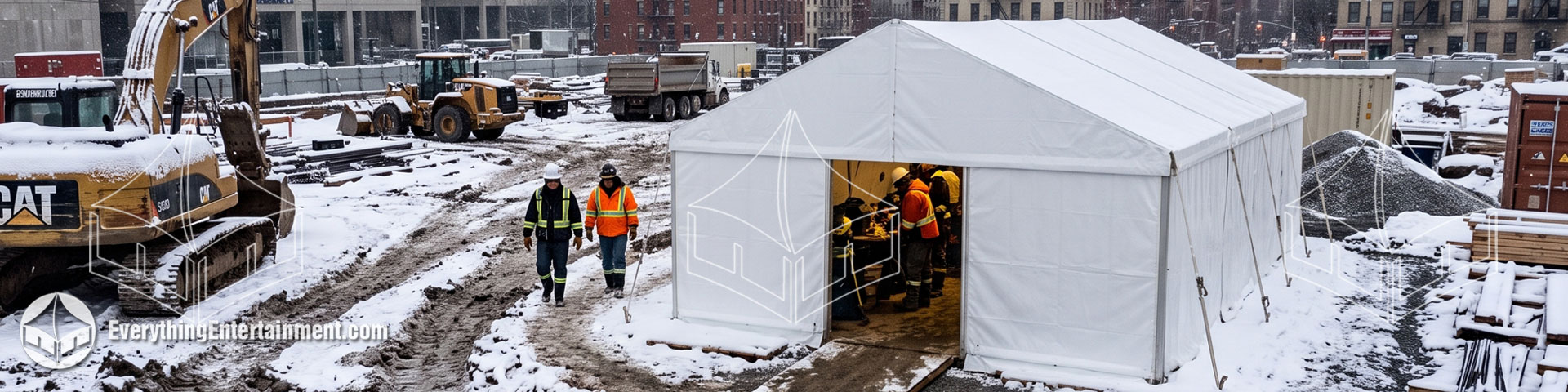
Heated, snow-rated tenting and engineered temporary structures for construction, industrial and corporate sites across New York City, Long Island and New Jersey.
Winter Tent Rentals & Temporary Structures in NYC & NJ
Since 1988, Everything Entertainment has installed 10,000+ tents and temporary structures across New York and New Jersey — including winter enclosures that keep construction and corporate operations running when the weather stops everyone else. We rent and install heated winter tents, engineered clearspan structures, temporary warehouse and storage tents, containment enclosures, power and lighting for job sites and facilities in all five NYC boroughs, Long Island, and New Jersey. Request a winter tent or temporary structure quote or call +1-718-556-3430.
By Everything Entertainment Editorial Team. Reviewed by Scott. Last updated: .
Winter Tenting & Temporary Structures Built for NYC & NJ Sites
Winter in the New York metro is not a season you work around — it is a season you plan for. Nor'easters, freeze-thaw cycles, sustained wind between buildings, and short daylight hours all hit job-site productivity and building operations at the exact moment schedules are tightest. A winter tent rental or engineered temporary structure is what keeps concrete, mortar, coatings and equipment in specification, and keeps crews working instead of waiting.
Everything Entertainment has been installing tenting across New York and New Jersey since 1988, with over 10,000 installations, and over 250 five-star reviews, and a team fluent in NYC load-in logistics, DOB filing paths, and the anchoring realities of asphalt, deck, roof and grade. We handle the structure, the heating, the power, the lighting and the install — one vendor, one plan, one crew, one call when the forecast changes.
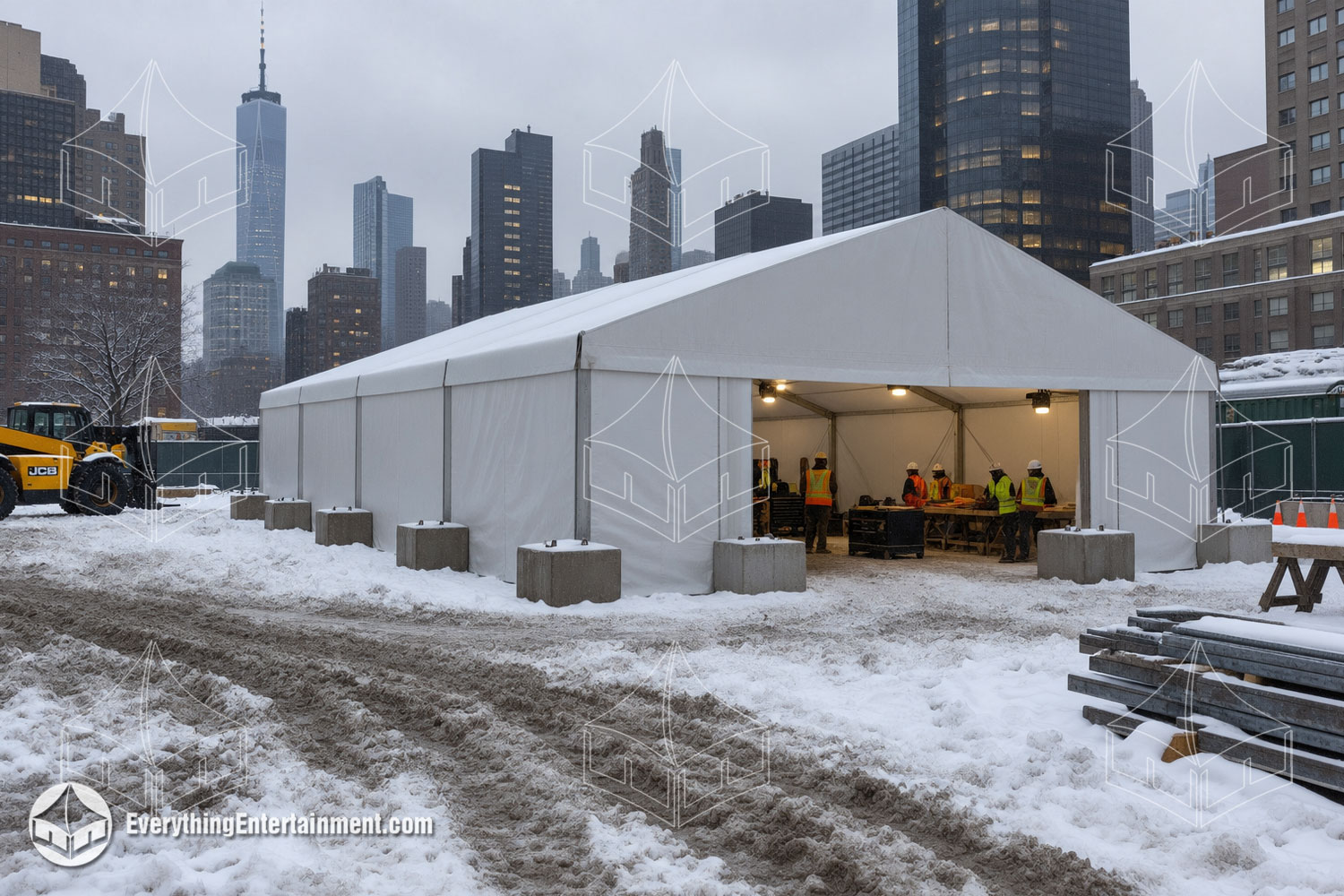
Construction & Industrial: Winter Job-Site Tenting
Keep the Schedule, Not the Weather Delay
For general contractors, construction managers, owners and industrial facilities, winter is where schedules are won or lost. We build heated, wind-tight enclosures around the work that cannot wait until spring — and we size the heating and power to the actual enclosure volume and the temperature your spec requires.
- Cold-weather concrete & masonry protection: heated enclosures for pours, block, mortar and grout, plus ground thawing for excavation and foundations.
- Coating, epoxy & flooring work: temperature-controlled shelter for finishes that fail outside their application range.
- Material & tool protection: dry, secure storage for equipment, fixtures, lumber and temperature-sensitive materials.
- Covered work bays: protected zones for facade, roofing, MEP, welding and fabrication trades through wind, rain and snow.
- Crew warming & break areas: proper heated break space, which is a cold-stress control measure, not a luxury.
- Containment enclosures: dust, debris and environmental containment around active work areas.
Clearspan structures are usually the right answer for job sites — no interior columns, wide clear spans, tall clear height, and roll-up doors for equipment access. See our temporary warehouse and storage tent page for storage-led projects.
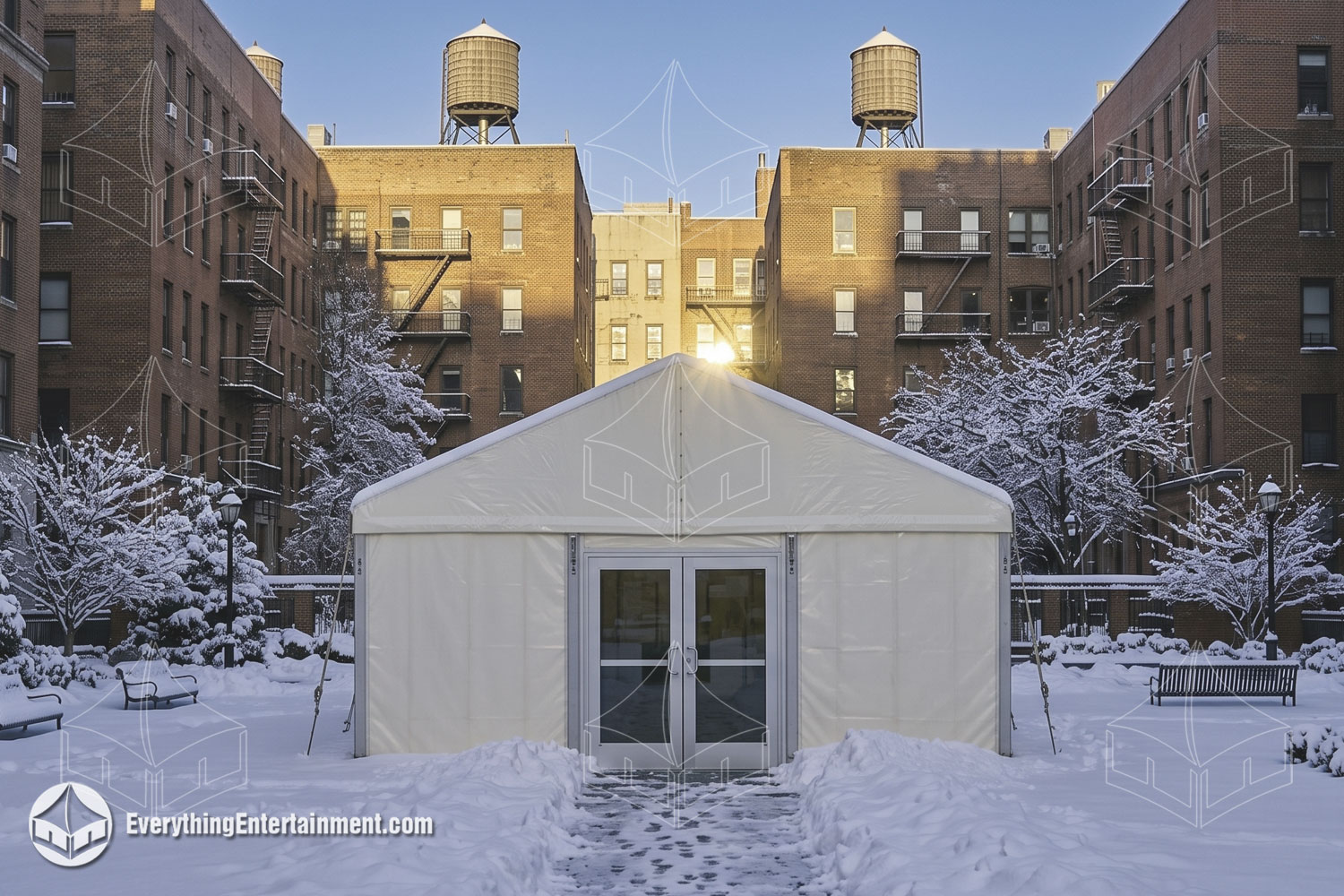
Corporate & Institutional: Winter Operations Tenting
Keep the Building, Campus and Brand Running
Corporate, institutional and facility teams use winter tenting and temporary structures for the same reason contractors do: work that cannot stop for weather. We support property management, campus operations, hospitality, retail and brand teams with structures that look intentional and perform in February.
- Building service & maintenance enclosures: temporary shelter over repairs, restorations and equipment replacement.
- Entry, lobby & porte-cochere protection: covered, heated transition space that keeps guests and staff out of the weather.
- Valet, shuttle & parking shelters: covered staging for vehicles and guests during winter operations.
- Loading dock & equipment protection: keep deliveries, inventory and mechanical equipment dry and in spec.
- Winter activations & events: heated branded environments for campaigns, launches and pop-ups that run through Q1.
- Emergency & continuity space: fast-deploy shelter for service interruptions and response operations.
For corporate winter events specifically — holiday parties, galas and year-end gatherings — see holiday party tent rentals in NYC & NJ.
Why Winter Tenting Fails — and How We Engineer Around It
Most winter tenting problems in the New York metro are not tent problems. They are planning problems: undersized heat, unavailable power, anchoring that ignores the surface, and snow that nobody is assigned to watch. We plan for all four before install day.
| Winter Risk | What It Does on Site | How We Engineer for It |
|---|---|---|
| Snow load | Accumulation is a live load that builds while the site is unattended — and drifts unevenly on long spans | Engineered structures planned for site exposure, anchored for the surface. Snow monitoring and removal is available as an optional service upgrade for the rental term |
| Wind | Urban wind tunnels and nor'easter gusts load sidewalls and attachment points | Correct ballast or mechanical anchoring for asphalt, concrete, deck or grade, plus sidewall and door configurations that stay tight under load |
| Freezing temperatures | Concrete, mortar, grout, coatings and adhesives fall outside specification; ground freezes | Heaters sized to enclosure volume and target temperature, insulated or solid sidewalls, ventilation, and ground-thaw capability |
| No usable site power | Heating, lighting and tools require load that the site cannot supply in winter | Temporary power generation and distribution planned as part of the package, with lighting and tool loads calculated up front |
| Permitting & filing | Unfiled or non-compliant structures stop work and risk violation | Support for the NYC DOB filing path with the structural documentation your design professional needs |
| NYC access & load-in | Tight streets, no staging room, difficult crane or delivery windows | Install sequencing planned around access, loading windows and building rules — the part out-of-area vendors get wrong |
Winter Performance Specifications
Winter rentals are specified, not guessed. When we quote a cold-weather enclosure we are working from the same inputs your engineer and superintendent are.
| Specification | What We Plan Around It |
|---|---|
| Target internal temperature | The temperature the work or the material requires — which drives heater sizing, sidewall specification and air management |
| Enclosure volume & clear height | Cubic footage, not floor area, determines whether the space actually holds temperature |
| Sidewall specification | Solid, windowed, insulated or clear — a direct trade-off between heat retention, daylight and the look of the installation |
| Heating type & placement | Direct-fired or indirect heaters positioned for even heat, safe clearance and ventilation |
| Power & distribution | Total connected load for heat, light and tools — with distribution and cable routing planned before delivery |
| Anchoring & surface | Asphalt, concrete, deck, roof, grade or protected surface — each has a different engineered answer |
| Flooring & sub-base | Level, load-bearing surfaces for crews, carts and equipment, including over frozen or uneven ground |
| Access & egress | Doors, roll-up openings and egress paths sized for the trades, materials and equipment that use the space |
Temporary Structure Types We Deploy in Winter
The right structure depends on span, clear height, duration, surface and the work inside it.
- Clearspan Structures: column-free spans and tall clear height for job-site work bays, storage and operations.
- Frame Tents: fast, flexible winter enclosures in standard 30x50, 40x60 and 50x60 footprints.
- Tent Sidewalls: solid, windowed, insulated or clear — the single biggest factor in heat retention.
- Heating & Climate Control: heaters sized to the enclosure and the temperature the work requires.
- Engineered Flooring: stable, level, load-bearing surfaces over grade, asphalt or deck.
- Temporary Lighting: task and safety lighting for short winter daylight hours.
Related capability: temporary warehouse, storage and construction tents · climate-controlled tent rentals · emergency response tenting.
Standard Sizes & Typical Winter Applications
Most winter installations in the New York metro use one of these configurations. Custom clearspan structures are available when you need wider spans, greater clear height or vehicle-scale openings.
| Structure | Approx. Area | Typical Winter Use |
|---|---|---|
| 30x50 Frame Tent | 1,500 sq ft | Small pours and masonry work, crew warming and break space, tool and material protection |
| 40x60 Frame Tent | 2,400 sq ft | Concrete and coating work, covered work bay, equipment and material staging, loading-dock protection |
| 50x60 Frame Tent | 3,000 sq ft | Multi-trade enclosures, temporary storage and assembly, campus and facility operations space |
| Custom Clearspan | 4,000+ sq ft | Wide-span job-site enclosures, vehicle and equipment access with roll-up doors, large-scale containment and operations |
Capacities and configurations vary by site conditions, exposure and structure specification. Final sizing is confirmed by site survey.
How a Winter Installation Works
1. Site Survey & Scope
We walk the site with your team: surface and anchor points, access and load-in route, power availability, clear height, work sequence and schedule.
2. Engineering & Filing Path
We match the structure to the load and exposure requirements, and coordinate with your design professional on the NYC DOB filing path where one applies.
3. Installation & Commissioning
Structure, sidewalls, heating, power and lighting go in as one package, with dates confirmed after the site survey and quote. Emergency service may be available for time-critical winter work.
4. Winter Monitoring & Service
Through the rental term we support service, adjustments and reconfiguration, and handle removal when the season or phase ends. Snow monitoring and removal is available as an optional service upgrade.
Coverage Across New York City, Long Island & New Jersey
We install winter tents and temporary structures throughout the region, including:
- New York City: Manhattan, Brooklyn, Queens, the Bronx, and Staten Island — including rooftops, courtyards, tight street access, and high-rise installations.
- Long Island: Nassau and Suffolk counties, from commercial and industrial corridors to estate and campus sites.
- New Jersey: Northern, Central and Shore communities — including Tenafly, Saddle River, Princeton, Rumson, Deal and Spring Lake.
Because we work in NYC every week, we plan around DOB, DOT and parks requirements, load-in logistics and tight urban access as a matter of routine.
Winter Work We Support
Construction & Industrial
- Concrete, masonry and grout protection
- Ground thawing and excavation support
- Coating, epoxy and flooring enclosures
- Facade, roofing and MEP work bays
- Crew warming and break areas
- Material, equipment and tool storage
- Dust, debris and environmental containment
- Temporary warehouse and staging space
Corporate, Institutional & Facility
- Building service and maintenance enclosures
- Entry, lobby and porte-cochere protection
- Valet, shuttle and parking shelters
- Loading dock and equipment protection
- Winter brand activations and pop-ups
- Campus and facility operations space
- Emergency and continuity shelter
- Temporary overflow storage and workspace
These are typical project types, not individual engagements. We publish examples of completed installations on our portfolio.
Why Teams Hire Everything Entertainment for Winter Work
Local Since 1988
Over 38 years and 10,000+ installations in the same market your project is in. We know what a nor'easter does to a sidewall on a Brooklyn rooftop and what a DOB filing actually requires.
One Vendor, Full Scope
Structure, sidewalls, heating, flooring, power, lighting and installation from a single team — fewer gaps, fewer delays, one point of accountability.
Licensed, Insured & Documented
Fully licensed and insured across NY and NJ, with the structural documentation, certificates of insurance and compliance paperwork commercial projects require.
Built for Cold Weather, Not Adapted to It
We specify heating, insulation and anchoring for winter conditions up front, and offer an optional snow monitoring and removal service as a rental-term upgrade.
Standards & References
Winter work is regulated work. These are the public standards and requirements we plan against — confirm the specifics that apply to your project with your design professional and the authority having jurisdiction.
- NYC DOB — Temporary Use Permit / temporary structures: temporary structures must generally be filed as a separate alteration in DOB NOW. nyc.gov/site/buildings/industry/tup.page
- NYC Administrative Code § 28-111.1.1: permits for the erection and use of temporary structures, including the exemption for temporary tents under 400 gross square feet used for not more than 30 days. codelibrary.amlegal.com
- NYC Building Code § 1608 — Snow Loads: design snow loads are determined under Chapter 7 of ASCE 7. codelibrary.amlegal.com
- NY State Fire Code, Chapter 31 — Tents, Temporary Special Event Structures and Other Membrane Structures: tents and membrane structures greater than 7,500 sq ft must be designed and constructed to comply with the referenced structural sections. codes.iccsafe.org
- ACI cold-weather concreting guidance: concrete is commonly required to be maintained at or above 50°F (10°C) for at least the first 48 hours after placement, with longer protection periods often specified. For Construction Pros
- OSHA cold-stress guidance: employers are expected to evaluate and control cold-related hazards for crews working outdoors in winter.
Frequently Asked Questions
What is the difference between winter tent rentals and temporary structures?
Winter tent rentals typically refers to tents and enclosures equipped and configured for cold weather — sidewalls, insulation, heating, lighting and winter anchoring. Temporary structures is the broader category of engineered, code-referenced structures used for job sites, storage, containment and operations, including clearspan structures and larger framed tents. Everything Entertainment provides both, and can specify either for a winter installation in NYC or New Jersey.
Can a tent be used to protect concrete curing in cold weather?
Yes. Heated enclosures are a standard cold-weather concreting measure. ACI guidance commonly cited for cold-weather concreting calls for concrete to be maintained at or above 50 degrees Fahrenheit for at least the first 48 hours after placement, and longer protection periods are often specified. A properly sized, heated and wind-tight enclosure is what makes that temperature hold practical on an open job site. Final curing requirements should always be confirmed with the project engineer and the placing contractor's specification.
Do winter tents and temporary structures in NYC require a permit?
Often, yes. New York City generally does not require a permit for temporary tents of less than 400 gross square feet used for no more than 30 days, but larger tents, longer durations and temporary structures are commonly filed with the NYC Department of Buildings, typically as an alteration filing through DOB NOW. Because job-site enclosures regularly exceed those thresholds, we work with your team and a licensed design professional on the filing path and provide the structural documentation the filing requires.
Are your temporary structures engineered for snow and wind loads?
Yes. New York design snow loads are governed by the New York City Building Code and ASCE 7, and installations must be engineered for the site's actual exposure. We supply engineered structures with anchoring planned for the surface, and we offer snow monitoring and snow removal as an optional service upgrade, because snow load is a maintenance issue as much as a design issue.
How quickly can a winter job-site tent be installed in NYC or NJ?
Scheduling depends on structure size, site conditions, permitting and current inventory, so installation dates are confirmed after the site survey and quote are approved. Emergency service may be available for time-critical winter work — call to confirm current availability.
Can you heat a tent on a job site that has no permanent power?
Yes. Job sites frequently have limited or no usable permanent power in winter, so we plan the electrical side of the project as part of the rental: temporary power and distribution, heaters sized to the enclosure volume and the required temperature, lighting, and load planning for tools and equipment. Power and heating are designed together, not added after the tent is up.
What can a winter tent be used for on a construction site?
Common uses include heated enclosures for concrete, masonry and epoxy work, ground thawing, weather-protected material and tool storage, covered work bays for facade, roof and MEP trades, crew warming and break areas, dust and debris containment, and temporary office, staging or assembly space. We configure the structure around the work, not the other way around.
Do you provide temporary structures for corporate and facility operations in winter?
Yes. Corporate and institutional clients use winter tenting for building-service and maintenance enclosures, entry and porte-cochere protection, valet and shuttle shelters, loading-dock and equipment protection, winter activations and campus operations. We handle the same scope for a corporate campus as for a construction site: engineered structure, heating, power, lighting, sidewalls and installation.
What tent sizes do you rent for winter and job-site use?
We rent 30x50, 40x60 and 50x60 frame tents plus custom clearspan structures for wider spans, greater clear height and vehicle-scale roll-up doors. Configurations can include insulated or clear sidewalls, doors, partitions, ventilation, HVAC, lighting and engineered flooring.
How long can a temporary structure stay up in New York?
Temporary structures are, by definition, time-limited, and codes also address separation from lot lines and other structures. Some winter installations run for a single project phase and others run all season. We plan the rental term and the code path up front so the structure is not overrun by duration limits, and our optional snow monitoring and snow removal service can cover the full rental term.
Where in New York and New Jersey do you install winter tents and temporary structures?
We install across all five New York City boroughs, Long Island (Nassau and Suffolk counties), and New Jersey from the northern suburbs and Newark/Jersey City corridor through Central New Jersey and the Jersey Shore.
How much does a winter tent or temporary structure cost?
Cost depends on size, duration, heating and power requirements, ground conditions, sidewall and insulation specification, permitting and site access. Winter installations carry real heating and monitoring costs, so packages are quoted per project rather than by a single rate. We provide a written quote after a site survey.
Request a winter quote or call +1-718-556-3430 to scope a winter tent or temporary structure for your NYC or NJ site.